




Japan Kneader Dough Sheeter, 15.5-inch
- Saves hours on lamination
- Consistent layers every time
- Handle up to 1.2 kg (2.6 lbs) of dough
- For home or micro-bakery batches
- Use for pastries, crackers, flatbread and more
- Quick and easy manual operation
- 55 thickness settings from 0 mm to 27 mm
- Board measures 15.5 x 39 inches
- Double sided board for rolling and cutting
- Folds compactly to store easily
- Detachable roller for easy cleaning
- Thoughtful, durable design
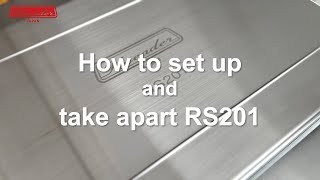
- Easy to assemble and clean
- 5 year home or commercial warranty
- Precision manufactured in Japan
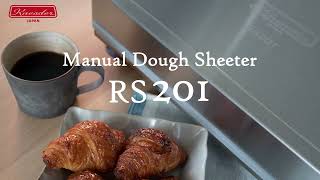
- RS201 Sheeter
- SB-04 Board
- Carrying case
- Instruction manual
$695.00
$850.00 (18.24% saved)In stock Usually ships in 1-3 business days.
Sheet Perfect Croissants, Danish & Puff Pastry in Minutes
Japan Kneader Dough Sheeter Sale
Save $155 on the 15.5-inch RS201 dough sheeter today!

Professional bakers have long relied on expensive automated dough sheeters, but home bakers haven’t had an affordable, high quality option. Now, both aspiring home bakers and small bakery owners can achieve flawless dough with ease. The Japan Kneader 15.5-inch RS201 dough sheeter speeds up the process and achieves professional-level precision. With the RS201 Japan Kneader Sheeter you can easily sheet up to 1.2 kg (2.6 lbs.) of dough at a time. For context, that comes out to 12 large croissants or 12 medium cinnamon rolls (100 grams each).
Japan Kneader is renowned for exceptional precision engineering, rigorous quality control, and meticulous attention to detail—qualities rooted in a manufacturing tradition that prioritizes performance, durability, and long-term reliability. These qualities stand in sharp contrast to the compromising approach so prevalent today, and are the reason why PHG is proud to represent Japan Kneader’s products. Their superior design and construction—backed by long warranties—will make your baking more fun and much more productive for years to come.
The RS201 Japan Kneader dough sheeter helps bakers achieve consistent dough thickness and professional-quality results with less effort. It is particularly well suited for laminated pastries, where even thickness is essential for creating distinct layers and a light, flaky texture. Popular laminated products include croissants, Danish pastries, puff pastry, kouign-amann, and cruffins.
Its versatility extends far beyond laminated doughs. The sheeter can also be used to roll and refine pizza dough, pie dough, tart dough, flatbreads, and certain pasta doughs, making it a valuable tool for both home bakers and small-scale commercial production. Dough sheeters are also excellent for making crackers and are commonly used for that purpose in both commercial and artisan bakeries; a dough sheeter can produce sheets that are much more uniform than hand rolling, resulting in crackers that brown evenly and have a more consistent snap or crispness. By reducing the need for repetitive rolling by hand, the sheeter improves consistency, saves time, and allows bakers to work more efficiently while exploring a wider range of recipes.
Many bakers also use the sheeter when making sourdough viennoiserie. Croissants, Danish pastries, cinnamon rolls and cruffins made with sourdough starter develop a more complex flavor profile thanks to the longer fermentation process. The result is a pastry with subtle tangy notes that complement the rich butter flavor, along with a delicate crumb and excellent flakiness.
Recommended Uses

The Japan Kneader dough sheeter performs best with doughs that are moderately firm, extensible, and well rested. Ideal applications include:
- Croissants, Danish pastries, and other laminated doughs
- Puff pastry
- Pizza dough
- Pie and tart dough
- Flatbreads
- Cracker dough that's firm but pliable, and not excessively sticky
- Certain pasta doughs with relatively low moisture content (read more about pasta below)
- Sourdough pastry doughs that are not excessively sticky
- Firm cookie doughs for roll-out cookies, including sugar cookies, gingerbread, shortbread, and Linzer cookies
Doughs That May Be Challenging
As a manual dough sheeter, the machine is less suitable for doughs that are extremely elastic, highly hydrated, excessively sticky, very dense, or unusually fragile. Examples include:
- Very high-hydration bread doughs
- Soft brioche doughs with high butter content
- Wet, sticky sourdough doughs before sufficient fermentation or resting
- Rich egg pasta doughs intended for thin, delicate pasta (read more about pasta below)
- Dense cookie doughs with high sugar content
- Crumbly doughs that lack cohesion
- Traditional phyllo dough for baklava (read more about baklava below)
Double-Sided Board for Greater Versatility
Japan Kneader's blue-white sheeter boards feature a patented multilayer construction, with an aluminum composite core sandwiched between layers of food-compliant synthetic resin. This structure provides far greater flatness, rigidity and durability compared to conventional single-layer white boards.

The board measures 15.5" wide by 39" long and is double-sided, with a white nonstick soft polypropylene surface for rolling and a blue high-density polypropylene surface for both rolling and cutting.
The white side offers exceptional smoothness, making it ideal for delicate rolling tasks such as cookie dough or fondant, where a gentler surface is preferred.
The blue side is intended for general dough sheeting for most pastry doughs and is durable enough to cut directly on. Bench scrapers and cookie cutters won’t damage the surface, though sharp pizza cutters or knives may leave scratches.
All materials are sourced and manufactured in Japan. The multilayer design resists mold growth and eliminates the risk of splintering, ensuring hygienic and dependable surfaces for professional baking and pastry environments. By paying close attention to internal components—not just visible surfaces—Japan Kneader enhances long-term reliability. The inner core also incorporates recycled polyethylene, reflecting their commitment to environmentally responsible material selection.
Designed to adapt to different ingredients and techniques, these double-sided sheeter boards are more than simple accessories—they play an integral role in achieving consistent, high quality results.
55 thickness settings from 0 mm to 27 mm
The RS201 sheeter offers a total of 55 easy-to-change thickness adjustments, ranging from 0 mm up to
27 mm, using two adjusters. The primary adjuster has 11 settings in 2.5 mm increments, allowing you to
quickly get close to your desired thickness. The secondary adjuster has 4 settings in 0.5 mm increments
and is used in conjunction with the primary adjuster for fine-tuning. Together, these adjusters let you
dial in any thickness from 0 to 27 mm in precise 0.5 mm steps. When the primary adjuster is set to its
smallest setting, the fine adjuster can reduce the dough thickness down to 0.5 mm. When the primary adjuster
is set to its widest setting (25 mm), the fine adjuster can increase the thickness from 25 mm up to 27
mm in 0.5 mm increments.
Removable Roller—Chilling Before Use
The RS201 dough sheeter features a removable anodized aluminum roller, which simplifies cleaning after use. More importantly for laminated doughs like croissants or puff pastry, you can place the detached roller in the freezer ahead of time to chill it thoroughly. Starting with a cold roller is a smart technique: it helps keep both the dough and butter layers properly chilled throughout the sheeting process. This is crucial because if the dough warms up too much, the butter begins to melt and blend into the dough instead of staying separated in distinct, crisp layers—ruining the lamination and resulting in denser, less flaky pastries. By maintaining that cool temperature from the start, you preserve clean separation between dough and fat for better rise, texture, and flakiness in the final bake.

Smooth & Intuitive Operation
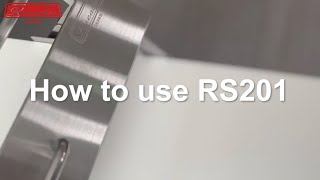
The RS201 dough sheeter features a straightforward manual hand crank that's smooth and intuitive to operate, even during extended sessions. The entire unit is built to last—durable yet remarkably lightweight at just 28 pounds (including the sheeter board), making it easy to move, store, or set up on any countertop.
You’ll need approximately 57" of side-to-side clearance to operate the RS201 sheeter, allowing the board
to travel fully from one end to the other through the rollers.
What truly sets it apart from most other manual sheeters is the synchronized drive system: the upper roller and hand crank are directly linked through a gearbox, so the roller rotates at a precise surface speed that matches the forward travel of the board beneath it.
In contrast, many competing sheeters rely on a passive upper roller that is merely drug along as the board pushes the dough against it. This often leads to unwanted smearing of the dough surface, uneven pressure, and inconsistent thickness—especially problematic when working with delicate laminated doughs where you need clean, uniform passes to preserve those distinct butter layers. With the RS201's driven roller design, you get reliable, even sheeting every time: no dragging, no smears, and far better control over your dough's final texture and rise.
Folding Design & Stainless Case
The RS201 sheeter/laminator features a folding design that allows its own components to nest together, forming a compact carrying case with a built-in handle. When folded into this case configuration, the unit measures 4.5 × 10.5 × 17.5 inches. The board stores separately.
We also offer Japan Kneader's compact 12 inch sheeter and their larger 21.6 inch sheeter.
Pasta Dough Considerations

Some pasta doughs can be successfully sheeted, but results depend heavily on the dough formulation. Firmer doughs made with semolina flour and little or no egg generally perform best because they maintain their structure and pass through the rollers cleanly. Doughs that are drier, less sticky, and properly rested are typically easier to sheet.
Egg-based pasta doughs can often be adapted for use in a sheeter by reducing hydration, increasing semolina content, and allowing additional resting time. However, very soft, rich pasta doughs may stick to the rollers or tear during processing.
In Japan Kneader's testing, they found that pasta dough can be challenging to process because it generally needs to be rolled much thinner than the intended range of their dough sheeter. For the final pass, they run the dough through the machine with the roller gap set to 0 mm. However, due to the dough's elasticity and spring-back, the finished dough is typically around 1–2 mm thick. As a result, the finished dough tends to be thicker than what is typically used for standard flat pasta such as fettuccine or tagliatelle.
Based on Japan Kneader's testing, their dough sheeter can be suitable for pasta made with thicker sheets
of dough such as lasagna and ravioli. However, they do not recommend it for thinner pasta styles such
as fettuccine, tagliatelle, or similar fresh pasta sheets that require a finer final thickness.
Why Baklava and Phyllo Dough Are Not Recommended

Traditional phyllo dough used for baklava is stretched to an exceptionally thin thickness, often approaching translucency. Because a dough sheeter compresses dough between rollers rather than stretching it by hand, phyllo dough can tear, shear, or stick during processing. For this reason, the Japan Kneader dough sheeter is not recommended for producing traditional phyllo or baklava sheets.
Best Practices for Successful Sheeting
For optimal results:
- Allow dough to rest adequately before sheeting to relax gluten.
- Lightly flour the dough and rollers as needed to prevent sticking.
- Reduce thickness gradually through multiple passes rather than forcing large reductions in a single pass.
- Keep laminated doughs cool throughout the process to preserve butter layers.
- Avoid feeding dough that is excessively wet, sticky, or warm into the machine.
Following these guidelines will help maximize the performance of the Japan Kneader dough sheeter and ensure consistent, professional-quality results across a wide variety of baked goods.
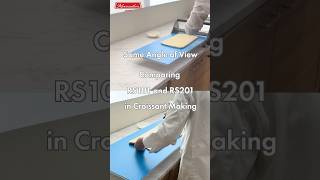
Japan Kneader ComparisonWhich model is right for you? |
|
|
RS101 |
RS201 |
RS301 |
| Board Width | 12" | 15.5" | 21.6" |
| Board Length | 27.5" | 39" | 47.2" |
| Dough Capacity* | 600 grams | 1200 grams | 2000 grams |
| Thickness Settings | 10 | 55 | 65 |
| Thickness Range | 0-17.5 mm | 0-27 mm | 0-32 mm |
| Detachable Roller | — | ✔ | ✔ |
| One-Handed Thickness Control | — | — | ✔ |
| Foldable | — | ✔ | ✔ |
| Self-Contained Case | — | ✔ | ✔ |
|
*The maximum dough amount shown above is based on bread dough rolled out to 3mm thickness. Depending on your preferred dough thickness, you may be able to roll more than our suggested amount of dough. However, please note that using dough amounts significantly above the recommendation may place extra stress on the machine. |
|||
Wheat Beat's Review of Japan Kneader Dough Sheeter
Click here to read Mike Barniv's review of his Japan Kneader's RS201 Dough Sheeter.
THIS PRODUCT IS MADE IN JAPAN!

Specs
Shipping
Accessories for this product:

Engineered specifically for the Japan Kneader RS201 Dough Sheeter, this precision crafted dough curling chain rolls dough for recipes like Japanese milk bread (shokupan). Built with durability in mind, the 304 stainless steel dough curling chain is easy to install and seamlessly integrates with your Japan Kneader RS201 dough sheeter, making it an easy upgrade for anyone seeking professional quality baking results at home or in a small bakery.
In stock Usually ships in 1-3 business days.
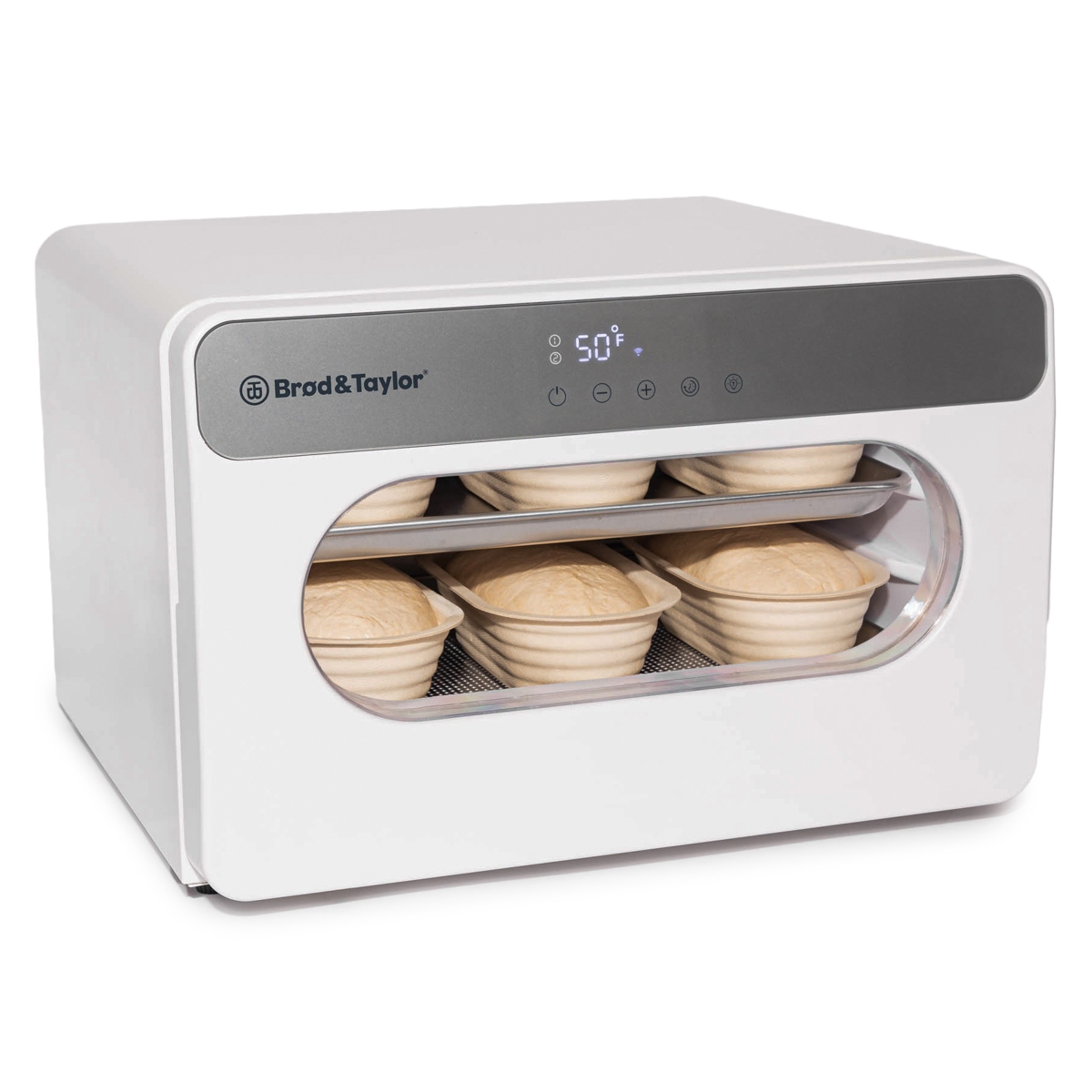
The Proofer Pro from Brod & Taylor sets a high standard for dough preparation with its combined warming and cooling capabilities. It is designed to meet the needs of both home bakers and small commercial kitchens.
Consistent, Professional Results
Bring professional level dough fermentation into your kitchen with the first all-in-one dough environment designed for serious home bakers. The Proofer Pro combines warm proofing up to 122 °F, cold retarding down to 41 °F, and precise humidity control in a single unit, giving you complete control over every stage of the fermentation process.
This innovative appliance both warms and cools, making it the only home dough environment that supports the full spectrum of professional fermentation techniques. Whether you’re proofing enriched doughs or slowing fermentation for deeper flavor development, this proofer delivers consistent, reliable results.
In stock Usually ships in 1-3 business days.

The Brod and Taylor Bread Proofer does more than just proof bread dough. Use it to make homemade yogurt or set it to a low temperature for pizza dough. You can also melt chocolate and butter without any fear of burning these delicate ingredients.
In stock Usually ships in 1-3 business days.

Rofco bread proofers heat up to 140°F and includes a removable water tank. The glass door makes it easy to see the progress of your proofing dough. Available in two sizes, with space for six proofing trays each. Proofing trays are not included. Click here for durable blued steel trays that fit the Rofco bread proofers and stone ovens. The width and depth dimensions match the Rofco baking tray dimensions (the small oven trays fit the RK30 and the large trays fit the RK48), and these trays are ideal for proofing your dough on.
The height between proofing trays is 3.75".
See the table below for a comparison of specs.
For more details see the specs tab, above.
See proofing baskets and liners here and click here for stone bread ovens.
Login
1 - 10 of 13 reviews
I bought this because I love laminated doughs and I'm a perfectionist. The idea of so many adjustments and perfect layers made this something I really wanted. It's so easy to use and the difference in results from hand rolling is amazing!
I received this product yesterday and used it for the first time today. I was greatly impressed by how well-designed it is. Every single piece looks thoroughly designed to make it as efficient and compact as possible. Today I tested it with a little over 1kg of croissant dough (enough for about 12 croissants per my recipe), and so far it has performed beautifully. It’s very easy to set up and use, and finally I don’t get a full body workout trying to roll croissant dough.
The unit folds away nicely and is very well designed. The one thing that jumped out at me was that the unit was built without compromise. The engineers and factory seemed to be committed to offer a well designed and constructed unit... much higher than many of us are accustomed to in this day and age. I think if there was any one issue I would prefer an improvement in would be the design of the micro adjustment dial. It is not bad but the rest of the unit just seems to be at such a higher level of design. Not a deal breaker and certainly not an issue..I would rate the design and functionality of the micro adjustment knob as GOOD but I would not rate it as the rest of the unit which I consider EXCEPTIONAL.
You cannot go wrong with this unit...it folds and stows away easily about the size of a small tool box and is quick to assemble and disassemble. I am sure that the first though that will come to your mind will be the same that came to mine....EXCEPTIONAL QUALITY.
The RS201 is a solid sheeter, and is made of steel. The rolling board is 39.5” long and is synthetic. There is a learning curve with any piece of equipment. This was no different. The settings are not easy readable. This sheeter is made for micro bakeries. But they have two other models, one for home use and one for larger commercial production. I also want to say thank you to the staff at PHG for being so helpful. I will post my full video on YouTube.
This machine is incredibly practical and efficient. The results are truly professional, and the Japanese quality is definitely there!
I'm very satisfied with the RS201. The assembly process was straightforward, and the materials are of excellent quality. It's easy to use and thoughtfully designed.
I recently got this dough sheeter and was able to use it as soon as I laid it out, and it does wonderful. Very easy and straightforward.
I'm very happy with the sheeter; it works very well. I've already made several puff pastry batches without any effort!
I now bake triple the amount of croissants a day. It’s very practical, easy to setup and disassemble, the process of sheeting the dough saved me at least 80% of the work. I can now make triple the amount of croissants I used to make a day. It’s great for home or small bakeries.
The RS201 sheeter is excellent for rolling out all kinds of dough. Pastries and puff pastry turned out beautifully.


Featured Items
.jpg?ts=1722446879)
.jpg?ts=1722447034)


.jpg?ts=1722440160)
.jpg?ts=1722440160)
.jpg?ts=1722440160)
.jpg?ts=1722440159)


.jpg?ts=1722440158)
.jpg?ts=1722440161)

.jpg?ts=1722440161)

.jpg?ts=1722440158)
.jpg?ts=1722440160)

.jpg?ts=1722440159)
.jpg?ts=1722440158)
.jpg?ts=1722440168)

.jpg?ts=1722440161)
.jpg?ts=1722440158)
.jpg?ts=1722440160)
.jpg?ts=1722440161)
.jpg?ts=1722440158)
.jpg?ts=1722440157)
.jpg?ts=1722440160)


.jpg?ts=1722440158)
.jpg?ts=1722440159)
.jpg?ts=1722440158)
.jpg?ts=1722440158)
.jpg?ts=1722440160)
.jpg?ts=1722440160)
