
Wheat Beat's Review of Spiralmac SV12 Royal Queen Mixer
By Mike Barniv of Wheat Beat, 12/17/2025, reproduced by permission.
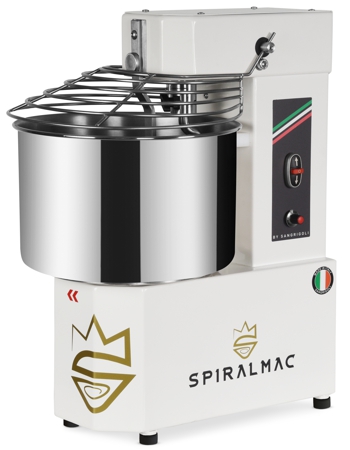
Disclosure: Pleasant Hill Grain provided this Spiralmac SV12 mixer to me at no charge for review and testing. They asked only that I share my honest impressions.
Equipment Review: Spiralmac Royal Queen SV12 Spiral Mixer
More spiral mixer options are finally making their way into the United States, and the Spiralmac SV12 Royal Queen is the newest one I’ve been testing. In this review, I’ll walk through the technical details, what I liked, what I didn’t, and how it compares to its closest competitor in this size range, the Famag spiral mixer. To see how it performs in real use, I ran it through four doughs, from pan pizza and pita to baguette and a sourdough olive bread. I’ll also be posting a YouTube video soon that highlights many of the features covered here.
Build quality and design
As with the past two mixers shipped to me by Pleasant HIll Grain, this one came meticulously packaged to withstand a drop from 30,000 feet! It arrived in a large outer box filled with packing peanuts, with a second inner box holding the mixer. Thankfully the peanuts were biodegradable, which meant my kids had a great time dissolving them in water instead of tossing them in the trash. That inner box had more padding around a tightly wrapped machine. It took some effort to get through all the packaging, but it was reassuring to see the mixer protected so well.

Take a look at the size of the box being assessed by an equally massive Rhodesian Ridgeback.
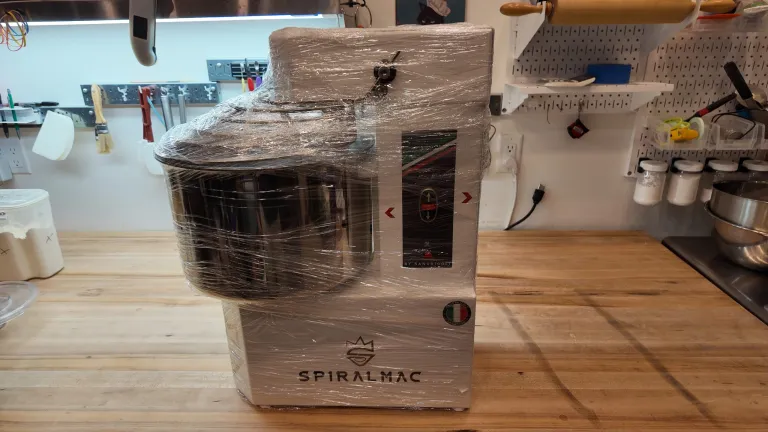
Out of all the packaging, the machine is wrapped tight like a mummy.
If you told me this machine was designed by people who lived in the world of long-lived commercial equipment, I’d believe it. The motor, gearbox, bars, and chains look like stuff you’d see inside a commercial bakery mixer. The spiral is a thick and heavy stainless steel part, same with the breaker bar. The metal safety grate is anchored by a solid rod. There’s no ornamental fluff here, just engineering choices that feel intentional.
In case you want to learn more about spiral mixers and why they are the machine of choice for serious baking, please read the first part of my review here.
The Spiralmac top portion doesn’t lift or tilt, but the bowl is still removable, a key feature. To do this, you first remove both the spiral and breaker bar, then the bowl lifts straight up and out. The breaker bar attaches with one screw and a locating pin. The spiral uses its own screw and attachment mechanism. These connections are tight and confidence-inspiring. You can tell some thought went into how much force and vibration these parts will endure. I did encounter a couple of quirks with both the spiral and breaker bar attachments, albeit minor, which I discuss further down in the review.
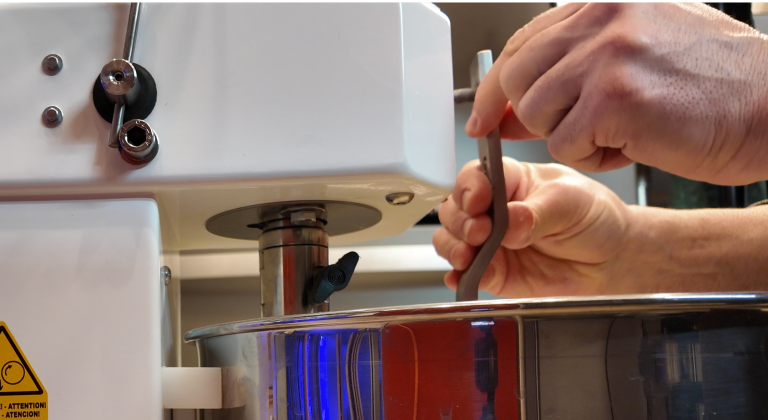
Here I am attaching the breaker bar. The spiral arm and bowl are already in place.
The bowl is hefty and wide to accommodate the maximum 12 kg of dough. It sits inside a somewhat tall (24.5 inches) and narrow (8 inch) machine. Although you can purchase optional casters, the standard machine comes with rubber feet. The machine feels planted even though it is relatively tall and narrow.
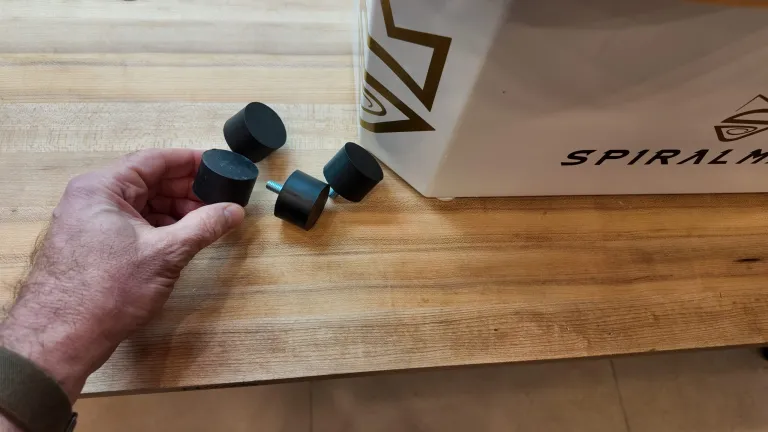
The four rubber feet I needed to attach to the machine. The feet you get with your machine might be a little shorter and thinner, but will accomplish the same thing. Casters are an option.
Capacity and bowl stability
The bowl-to-machine fit is very precise, which is partly why this thing runs so quietly. In the Famag mixer, for example (discussed below), the bowl is locked in place with a rotating mechanism. This can lead to clacking as the bowl rotates. The Spiralmac does not suffer from this issue at all. The bowl has four tall pegs (posts) that engage recesses in the rotating stage. In these recesses are spring loaded ball bearings that help further secure the bowl.
The one motion that takes some getting used to is aligning the tall posts into the narrow recesses on the stage. Once the 12.2-pound bowl is full of dough, you could easily be handling more than 35 pounds in total. Between the length of the pins, the ball-bearing retention, and the combined weight, it can take a fair amount of strength to manage everything at once. A simple workaround is to remove the dough in a few portions first, which quickly reduces the weight and makes the process much easier.
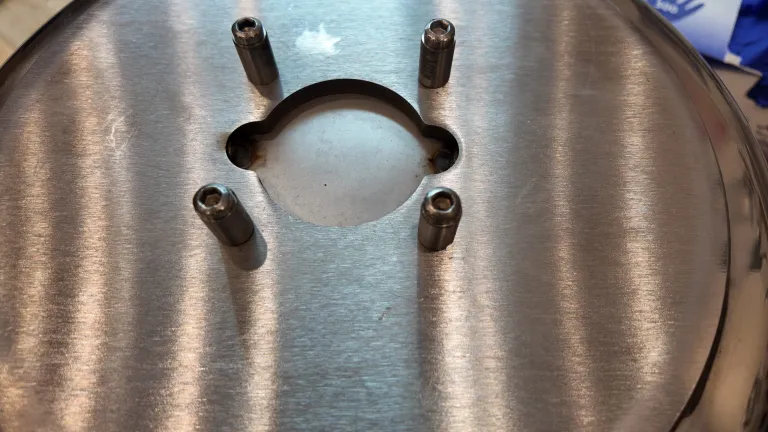
Underside of the Spiralmac bowl. Notice how close and long the four pegs are. This can cause the bowl to cant a little to the side in certain cases, which is not a big deal.
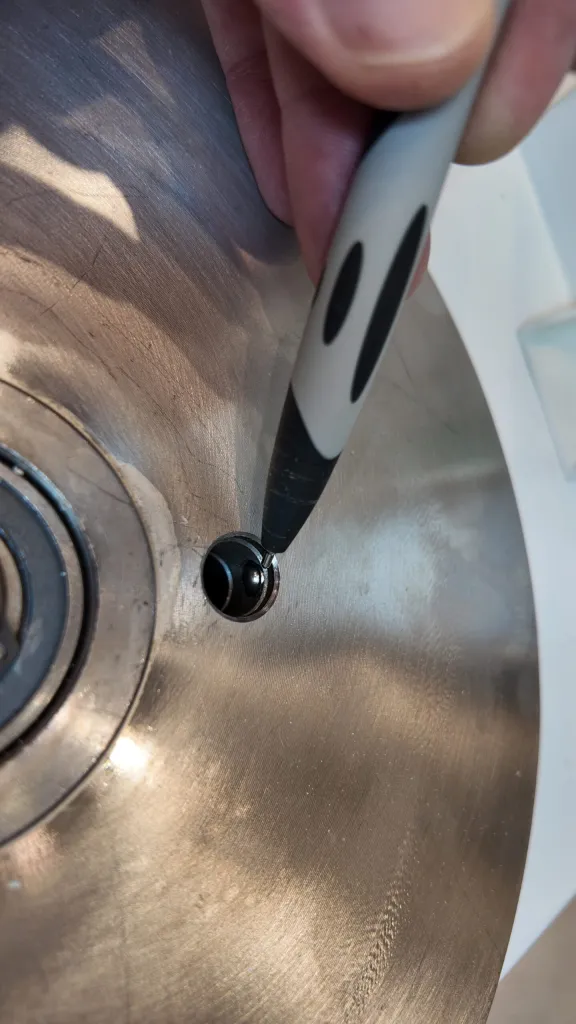
This is the bowl stage on the machine. Here you can see one of the recesses the bowl peg inserts into. Notice the ball bearing being pointed to. This helps further retain the bowl in place firmly.
Motor, speed, and power
The drivetrain is a chain driven system that feeds through an oil-filled reduction gearbox. That alone
puts it on a more industrial spectrum. The spiral runs at 310 RPM at top speed and the bowl rotates at
27 RPM. For high-hydration doughs, this relatively fast spiral speed matters, because wet dough takes
longer to develop gluten and needs more speed to keep the mass together during mixing. If you ever fought
slack dough, you’ll appreciate this. I say “relatively”, because the machine’s speed is faster than the
comparable Famag spiral mixer and closer to the “high-hydration” variant. All of this is discussed in
more detail in the comparison section below.

This is the machine insides looking from the back. Note the blue reduction gearbox which is connected
to the motor. This is connected to the long vertical metal rod (in the middle) that rotates. It drives
the two chains seen in the image. The top chain moves the spiral and the bottom chain moves the bowl.

This is the top view. The left gear is rotated by the metal shaft shown in the image above and it turns
the spiral on the right via a chain connection.

Closeup of the reduction gearbox. Note the metal shaft which is connected here to a second chain that
rotates the bowl. The reduction gearbox is a key feature of this machine, making it long-lasting and
quiet in operation.
There’s forward, reverse, and variable speed. I’m not a big fan of reverse (explained more below) and
I hardly ever change speed, but it’s there for those who want it. I mix at two speeds: the lowest to
incorporate liquids into the flour and at max speed for dough development. All the commercial machines
I have ever used had just 2 speeds. That is all I need, and the variable speed knob seems like one more
thing that could break (and it did after a few years on my Famag mixer that has the identical part!).
Most importantly though, the Spiralmac is quiet, smooth, and does not flex or shake.

Controls for forward, reverse, and stop. At the bottom is the variable speed knob. The Famag mixer uses
the same exact parts. My variable speed knob broke after a few years (the plastic knob, not the mechanism
itself).
Removable bar and specialized high-hydration bar
One of the truly awesome features of the Spiralmac is the ability to swap the breaker bar. Pleasant Hill Grain sells a specialized bar they call a “dough divider attachment” that is designed for high-hydration and small batches. As can be seen in the image, it has a protrusion at the tip which helps gather small batches or slack dough and “focus” the mass near the spiral. This makes it less likely for dough to stick to the bowl walls and spin around without ever touching the spiral. I tested this bar with 90 percent hydration dough, and it worked well. It kept dough folding on itself rather than smearing around.
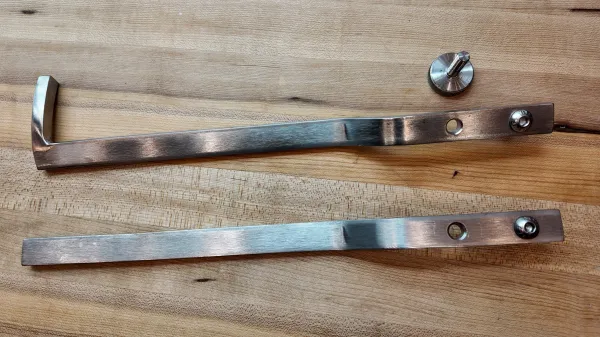
The bar on top is the high hydration/small batch option. Notice the protrusion that helps gather dough closer to the spiral, thereby making mixing more efficient. The straight bar under it is the standard one that ships with the machine.
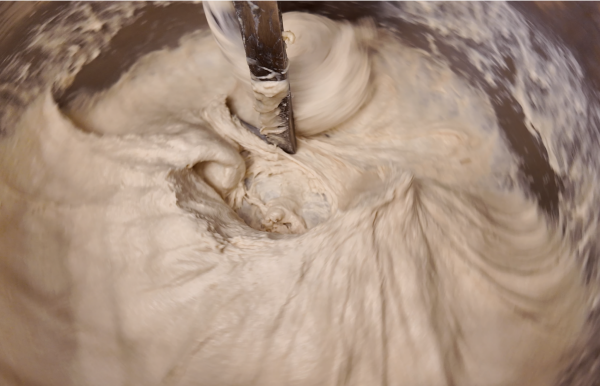
High-hydration breaker bar working on a small batch, 90% hydration dough.
Ease of use
The interface is simple with the aforementioned forward, reverse, stop, and speed knob. The safety grate lets you toss in salt or oil mid-mix without issue.
The breaker bar detaches easily. The spiral connection process, however, can be awkward depending on
where it stops. If the screw ends up pointing to the front, everything is easy. If it ends up behind
the spiral arm pointing backwards, like in the below image, it can be annoying. On one mix, I fumbled
the screw and it went straight into the dough. You’ll see this in the video. It’s not a big problem if
anticipated, but it does highlight a slight design quirk.

The spiral attached to the machine. Notice how the screw is facing away from me towards the back of
the machine. When the machine stops like this, access to the screw can be awkward.

Because the screw has a little lubricant on it, I almost always had some grease stains on my fingers
after disconnecting the spiral. This should be kept in mind if immediately handling wet dough with those
fingers.
Mixing performance
There isn’t a ton to say here other than it did exactly what I expect a spiral mixer to do. It kneads dough like large commercial mixers I’ve used. It’s quiet under load and dough develops fast. I put in 10 kilograms of dough and it didn’t slow, struggle, or strain at all. Yes, it’s rated for even more (12 kilograms at 60 percent hydration), but I would still expect it to indicate it was working hard with 10 kilograms. Yet, it purred along quietly, almost as if it was amused I thought I was pushing it.

Mixing 10 kg of dough like it was tossing a salad.
Cleaning
This is probably the biggest workflow win. Everything dirty comes off the machine and you put it all
right in the sink. Nothing stays attached. You don’t have to clean anything in a panic before dough dries
into cement. You can keep everything wet and clean it after you shape your dough. For anyone who bakes
a lot, this matters.
Things I wasn’t fond of
Already mentioned is that the spiral retaining screw can be somewhat awkward to reach in certain situations. It can also unscrew all the way out and land in your dough (which mine did). A captive screw design might have been better to prevent that screw from falling out completely.
The breaker bar screw is a knurled knob. With doughy fingers, I found it could be a challenging to get a good grip on it. Instead of a screw mechanism, a retaining pin with a ball detent release would have been more ideal.
Even when the breaker bar was affixed firmly, I did see slight movement issue while mixing dough. This was likely because the metal housing wasn’t hugging the bar precisely enough. Despite being tightly screwed in at the beginning of the mix, I found the bar gradually loosening as my mix progressed.
I told PHG and they immediately shipped me a new bar and housing. It was not a big deal to begin with,
but kudos to them for insisting on getting it rectified right away. They told me they’ve never heard
complaints about loosening, so my case may be a one-off. I will do some more testing and update accordingly
if this minor issue persists.

Apparently not a common issue, but my bar loosened as I was mixing. This is likely because the bar fitting
in the metal housing is not as snug as it could be, and this allows for some wiggle room. PHG sent me
a replacement and I will test it. But even if it doesn’t solve the issue, it is a minor grievance. It’s
solved by simply giving the knurled screw a little tightening if it starts to loosen.
As mentioned earlier in the post, I don’t like the reverse option on these single-motor machines. I’ve
never found it useful. On commercial machines, there is a separate motor for the bowl. So, when the spiral
direction is reversed, the bowl does not reverse direction too. With the single-motor design, both the
bowl and spiral reverse at the same time. Ultimately, this always resulted in my dough crawling up the
spiral and smashing against the ceiling of the machine. For me, at least, reverse is just a gimmick.
Also as mentioned above, I don’t use the variable speed option. Most bakers need low and high. That’s
it. But to be fair, I know people who like speed control, so this is more my preference than a flaw.
One note on the electrical cord, mine exits the machine in a way that doesn’t inspire confidence. I
did, however, verify internally that it’s secured and sealed. So, this is mostly cosmetic.

Here I’m holding the electrical cord exiting the machine. Notice there is a gap around it, and a grommet
would have been a good addition. I checked inside the machine and the cord is properly secured and sealed,
so this is cosmetic.
It’s a tall machine at 24.5 inches. This means it won’t be optimal on a countertop. I keep mine slightly
elevated below my workspace. Some bakers may put it on the floor. A more ideal solution is to place the
machine on a
dedicated cart with casters to give you maximum flexibility and access.
Overall
The Spiralmac SV12 is a terrific spiral mixer. I would give it 5-stars! It’s strong, quiet, efficient, robust, and extremely easy to clean. It did everything I wanted it to do. It has a few quirks, but they are all forgivable. I’ll be keeping it as my main mixer.
Pros
- Very strong drivetrain
- Quiet under load and powerful
- Specialized breaker bar option for high-hydration dough and small batches
- Bowl, bar, and spiral are all fully removable
- Excellent build quality
- Fantastic mixing characteristics
- Great support and warranty (4 years!) from PHG
- No grease, no belts
Cons
- Relatively tall, not ideal for countertop placement
- Spiral arm retaining screw and breaker bar attachment mechanisms could be improved
- Reverse feature isn’t practical in reality (but Famag has the same exact thing)
- Variable speed has limited application and unnecessary (IMHO)
Results

Yummy pan pizza!


Fluffy pita bread

Baguettes

Olive bread. My favorite!
Spiralmac SV12 vs Famag 10S
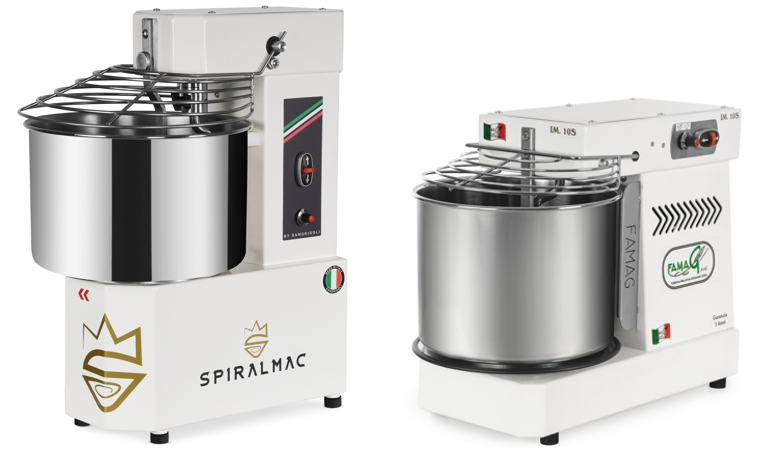
Let’s be honest, there’s an elephant in the room and its name is Famag. This was the original review I did in 2019, and I posted several follow up reviews of my experience and issues. Many readers will inevitably ask what the differences are and which is better. Here it is:
Physical Specs
The Famag 10S width is about 9.5 inches (without the bowl) with a height of 17 inches. The Spiralmac SV12 width (without the bowl) is about 8 inches with a height of around 24.5 inches. So, the Spiralmac is taller by about 7.5 inches and narrower by around an inch-and-a-half.
If you intend to place your machine on a countertop, the Spiralmac will be less suited there and better placed on a dedicated cart or on the floor. In terms of physical size, I prefer the shorter stature of the Famag.
Also, note that the physical specs of the Spiralmac are identical whether you get the 8 kg or 12 kg versions. The only difference between them is the bowl size and metal safety grate that covers it.
Weights
The Famag 10S is about 73 pounds (no bowl). The Spiralmac is 77.8 pounds (no bowl). They are surprisingly similar in this regard even though the Spiralmac looks beefier. Keep in mind that the Spiralmac bowl is significantly heavier than on the Famag, so the total weight difference with the bowl included is bigger. See below for more.
Bowls
First, a word on bowls in general: I’ve been asked many times how important a removable bowl is. I would not buy a spiral mixer without one. Once you get into larger machines, this option disappears and cleaning becomes a huge chore, especially with wet doughs. Whatever machine you end up choosing, do yourself a big favor and get one with a removable bowl!
Thankfully, both the Famag and Spiralmac offer removable bowls, so you’re safe either way. There are, however, significant differences in how they accomplish the feat. The Spiralmac allows you to take the bowl out by first removing the breaker bar and spiral arm. The Famag accomplishes it by lifting the entire top section up and away, giving you the clearance needed to lift the bowl out. There are pros and cons to each approach, and I discuss some of those below and in other sections.
The Famag bowl has an 11.5 inch diameter and holds 10 kg of dough at around 60% hydration, but it weighs only 4.8 pounds. The Spiralmac bowl has a 13 inch diameter and holds 12 kg of dough at roughly 60% hydration. It weighs in at a stout 12.2 pounds, about 7 pounds heavier than the Famag bowl. Obviously it is preferable to have a lighter bowl, but it’s also not fair to compare weights on bowls with different capacities. So let’s call this one a wash.
In terms of the connection of the bowl to the machine itself, the Spiralmac union is precise and silent. There is no locking mechanism or any moving parts involved. By contrast, the Famag bowl is connected via a locking plate that must be rotated to secure it in place. This design introduces slack which leads to noticeable chatter during operation. I’ve had to modify and fix my Famag machine’s locking mechanism and I know others have had issues as well.
As alluded to earlier in the post, the Spiralmac bowl protrusions are relatively tall and narrow. They are also much closer to the center than on the Famag. I assume this is because the same machine accommodates the 8 kg Spiralmac bowl, and that bowl is much smaller. In any case, having protrusions so close to the center allows the bowl to cant in certain situations. It’s not a major issue, since the bowl only leans to one side and never actually tips over. I would call this more of a quirk than a real problem.
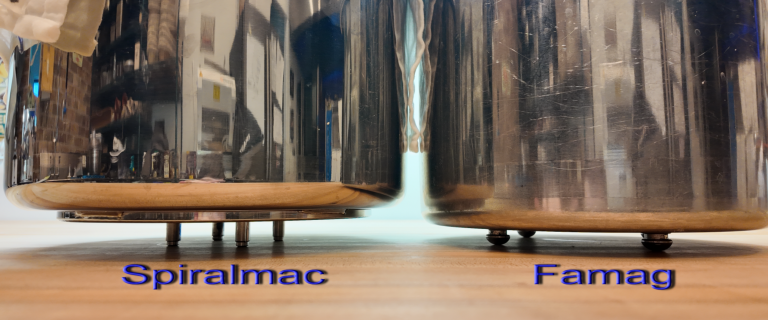
The Spiralmac on the left has four long and thin protrusions that secure it to the stage on the machine. Notice how close they are to the center relative to the Famag. This allows it to tilt to one side sometimes, which is also not a real problem. On the upside, it eliminates the need for a locking plate used on the Famag. It is also completely silent, unlike the clackity-clack you hear from the Famag mechanism during operation.
Speeds
My Famag 10S spiral runs at a maximum of approximately 245 RPM, while the bowl spins at 30 RPM. The Spiralmac spiral spins at 310 RPM while the bowl rotation is around 27 RPM. This means the Spiralmac speed is closer to the Famag High Hydration model. It’s not exactly a one-for-one though, because bowl size makes a difference when you consider speed of the spiral. Simply know that the Spiralmac is overall faster than the standard Famag.
Since you can use the dial to reduce the speed, I definitely prefer the Spiralmac for providing flexibility and the option to mix faster. Maybe it’s anecdotal, but the Spiralmac’s dough development felt closer to what I’m accustomed to with large commercial machines.
Small batches and high-hydration
Both machines can handle very small batches, which is fundamental to all spiral mixers. Even as little as ten percent of the rated capacity will usually work. But, since the Spiralmac SV12 has such a large capacity, some users may hesitate thinking they will rarely use its full range. This is where the Spiralmac’s swappable breaker bar becomes a major advantage. With the optional “dough divider attachment,” you can run even smaller batches or very high-hydration doughs with ease. Because the Famag’s breaker bar is fixed, you are stuck with a one-size-fits-all approach. Spiralmac clearly wins this round.
Remember the part above about Famag offering a “High-Hydration” model that runs faster? The Spiralmac essentially gives you those same high speeds while also letting you slow things down however you want. Combine that with the dough divider attachment option mentioned above, and you are effectively getting several machines in one. Spiralmac wins here again. Flexibility matters.
If you are on the fence between a 8, 10, or 12 kg machine, I always recommend going up in size. The optional dough divider attachment should give you piece of mind you’ll be able to handle a full range of batch sizes. Given that the Spiralmac is the only one with this option and it runs at higher speeds, I’d go with the SV12 model. The cost difference (only about 10%) between it and the SV8 is minor. Spend a little more and get the bigger machine.
Cleaning
Spiralmac wins by a wide margin on this point. Remove everything and wash later. Famag requires immediate cleaning or you’re scraping dried dough from the bar and spiral later.
Mechanics
Spiralmac has a chain driving both the spiral and bowl. There is an oil filled reduction gearbox that
is responsible for most of the power transfer. This gives it a more commercial feel. Famag uses belts
on the underside which serve as gear reducers. Although belts are less preferable to chains, the design
does save space and is what allows the Famag to be noticeably shorter than the Spiralmac. Belts, unfortunately,
wear out much faster than chains, and some have reported failure over time.

This is the underside of the Famag. I am pointing to the shaft that propels the smaller wheel via the
tan belt. This transfers energy to the top of the machine where a chain drives the spiral. It also turns
the larger wheel with the black belt, which then rotates the bowl. The Spiralmac has none of this, relying
on the sealed reduction gearbox instead.

The top of the Famag. The gear in the center is connected to the shaft that is driven by the tan belt
seen in the preceding image. This transfers motion to the gear at the top of the picture via a chain,
which ultimately rotates the spiral. This is the one and only chain on the Famag, while the Spiralmac
has two chains: one driving the spiral and one the bowl.
The other issue with the Famag, and it’s a big one fellow bakers, is the lifting head mechanism. This
was alluded to already in the “Bowls” section above, but I wanted to add more details here. In theory,
the concept is attractive: lift the head assembly up and retrieve the bowl. But, lifting that heavy piece
involves a hydraulic assist arm plus a greasy coupling that can develop alignment issues over time. Although
these latter problems have not occurred over my years of ownership, I have heard plenty of stories from
bakers who were less fortunate.

The Famag head assembly lifted up for bowl removal. Notice the greasy coupling in the middle which connects
the motor to the gears inside the head. A lot of issues potentially occur with that coupling. Also notice
there is a pressurized arm on the left holding up the heavy assembly. When the assembly is lowered, you
need to use the thumbscrews (I’m holding one) to lock it in place.
The Spiralmac has no lifting head assembly, no coupling, and no belts. It relies on chains and an oil-filled
high-end reduction gearbox. The result is improved robustness and a simpler, more durable design. Mechanically,
Spiralmac is the clear winner.
Warranties
Famag has a 3 year home warranty. The Spiralmac home-use warranty is 4 years. Both warranties are very generous. It’s surprising in this day and age to see anything past a year, so 3 years is a lot. And 4 years is more of a lot! 🙂 In any case, Spiralmac wins with this comparison.
Final Comparison Judgement
The Famag has been a reliable machine for me for seven years. It is unquestionably capable and remains a solid workhorse in any baking environment. Its one clear advantage over the Spiralmac is height, coming in roughly eight inches shorter. Beyond that, most practical considerations favor the Spiralmac.
Having owned and used both machines, and with both offered by Pleasant Hill Grain, the Spiralmac is the one I would choose if I were buying a new spiral mixer today. While no machine is perfect, the Spiralmac checks all the boxes that matter most to me: ease of cleaning, a simple and robust drivetrain, strong and consistent performance, flexibility with high hydration doughs, and confidence in long-term durability. If you are considering a new spiral mixer, the decision feels fairly straightforward. I would also reiterate earlier advice to buy a larger machine than you think you need, as the extra capacity quickly proves useful.
Conclusion
After putting the Spiralmac SV12 through everything from small test batches to fully loaded mixes, it consistently impressed me. The machine genuinely feels like commercial equipment scaled for the home and micro-bakery environment. Fast, smooth, durable, and easy to clean, it is just as comfortable with very small doughs as it is with heavy loads.
There are a few quirks, which I call out candidly in this review, but overall the experience is clearly better than alternatives such as the Famag. This will be my primary spiral mixer going forward.
Quick note on Pleasant Hill Grain
I highlighted Pleasant Hill Grain positively in this review because they earned it, period. I have worked with them for years, and my positive comments come from repeated experience and genuine respect. They run an honest business, their customer service is exceptional, and they stand behind what they sell. I say this sincerely. Pleasant Hill Grain is the place I recommend for serious baking equipment and supplies.

